Birds Startled by a Bow, Grass and Trees Mistaken for Soldiers
383 AD | Former Qin · Fu Jian
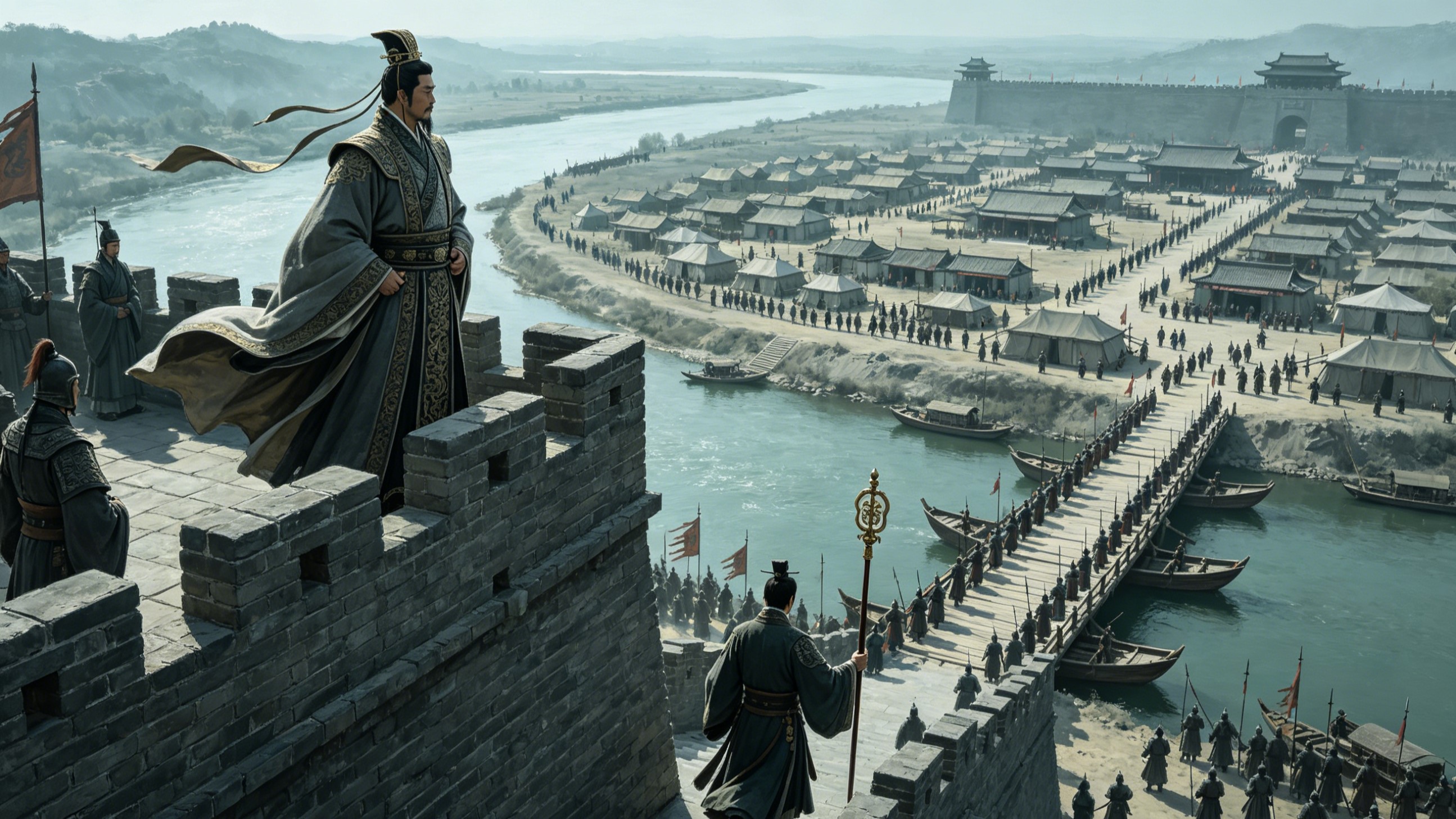
🎯 The Dream of Unification
In 383 AD, after years of conquest, Fu Jian, emperor of the Former Qin, had largely unified northern China. With a million soldiers under his command and vast territories, one ambition remained: cross the Fei River, crush the Eastern Jin in the south, and unite the entire realm.
Fu Jian excitedly told his brother Fu Rong: "With 870,000 troops, you just need to order the soldiers to throw their whips into the river, and the current will be blocked!" He mobilized his entire army, claiming over 900,000 men, and marched south in overwhelming force.
Little did he know that this war would become his most painful lesson.
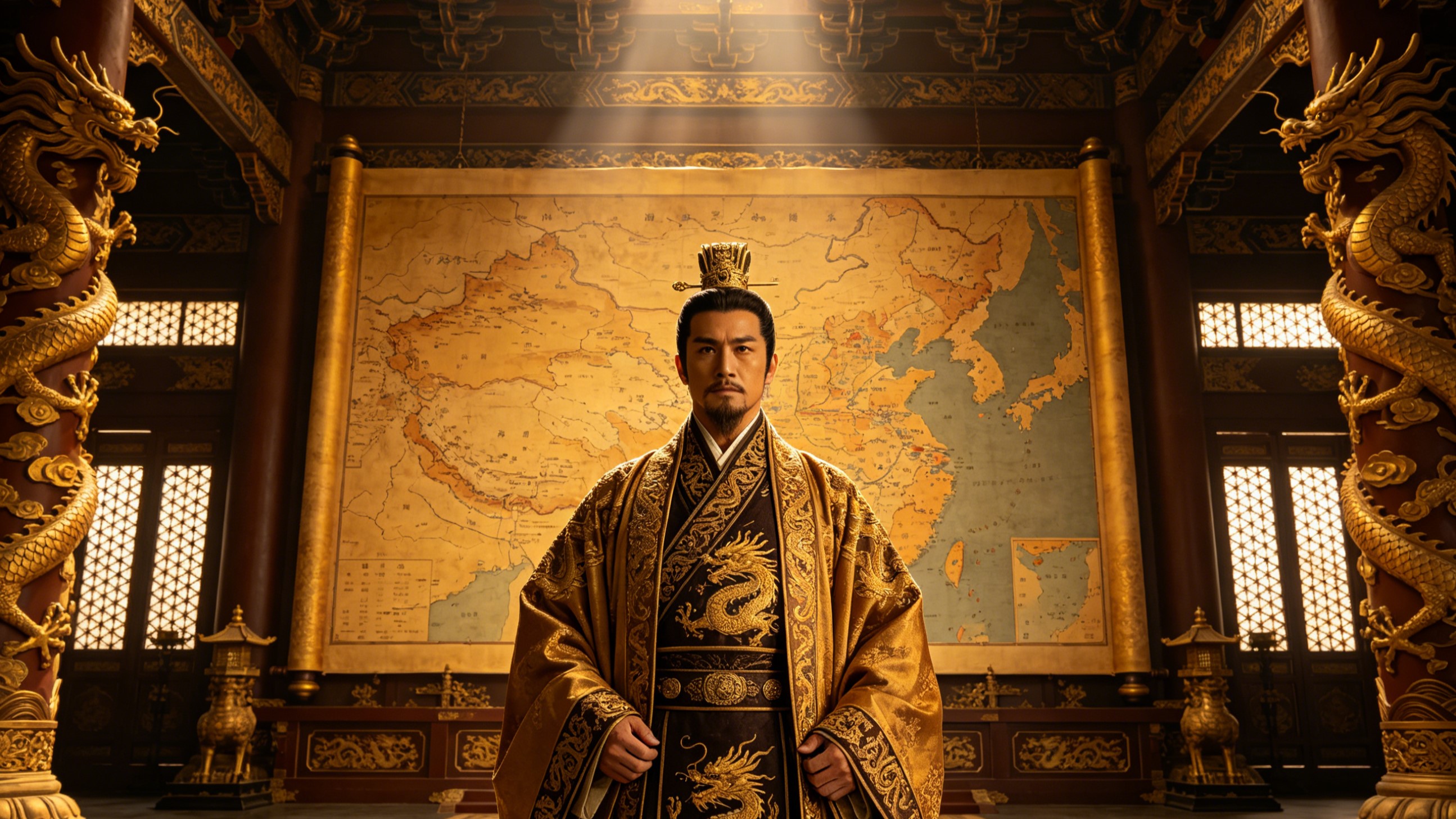
⚔️ Early Success and Arrogance
At first, everything went according to plan. Former Qin's vanguard captured the strategic city of Shouyang. Delighted by the news, Fu Jian left his main army to assemble slowly at Xiangcheng and rushed to the front lines with 8,000 light cavalry.
From afar, seeing his banners flying over Shouyang, Fu Jian was filled with pride. He recalled telling his generals: "The Eastern Jin is just a weak, dying court. With my million-strong army, can't I wipe them out with a wave of my hand?"
To win without fighting, Fu Jian sent the defected general Zhu Xu to the Jin camp to persuade them to surrender.
But Zhu Xu, still loyal to the Jin, secretly revealed the Qin army's weaknesses: "Their main force hasn't arrived yet. If you attack their vanguard now, you'll surely win!"
The Jin generals Xie Shi and Xie Xuan immediately ordered the fierce commander Liu Laozhi to lead 5,000 elite troops in a night raid on the Qin outpost at Luo Stream. The Qin forces, caught off guard, fell into chaos, and their vanguard was almost completely wiped out.
When the news reached Fu Jian, his heart sank.
😱 A Nightmare from the City Wall
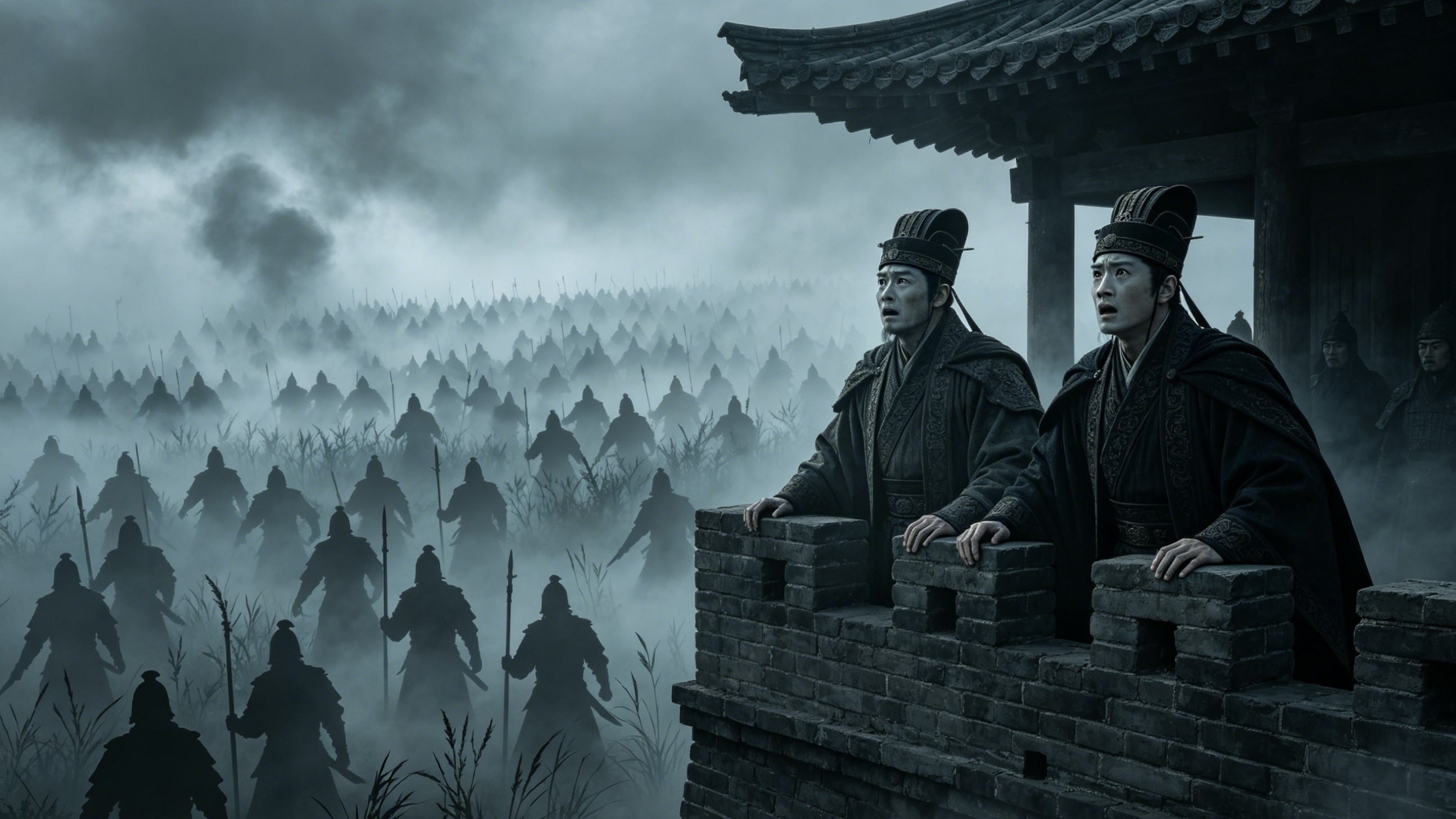
After the defeat, Fu Jian and his brother Fu Rong climbed the city wall of Shouyang to survey the Jin army across the Fei River. It was deep winter, gloomy and foggy. On the opposite bank, Jin banners fluttered, warships lined up, spears and swords glittered — the soldiers moved in perfect order. Fu Jian was secretly impressed: This was no weak army — they were formidable!
Then he instinctively looked north — toward Bagong Mountain.
It was the dead of winter, and the mountain was covered with withered grass and bare trees. A fierce wind swept through, and the rustling dry branches swayed wildly. In the thick fog, those moving grasses and trees looked exactly like thousands of training soldiers! Fu Jian's face turned ashen. He grabbed his brother's arm and whispered in terror: "What a powerful enemy! Who says they are few?"
A mighty emperor had mistaken the trees and grass on the mountain for enemy troops. This is the origin of the Chinese idiom "cao mu jie bing" — "every bush and tree looks like an enemy soldier."
💨 The Final Collapse
But the nightmare wasn't over. The Jin general Xie Xuan sent a messenger to the Qin lines: "You have come a long way, yet you array yourself by the river as if for a prolonged war. If you dare, step back and give us room to cross, and let us decide the outcome in battle!"
Fu Jian secretly rejoiced: while the Jin army was crossing, he could launch a charge and annihilate them. He immediately ordered his entire army to retreat.
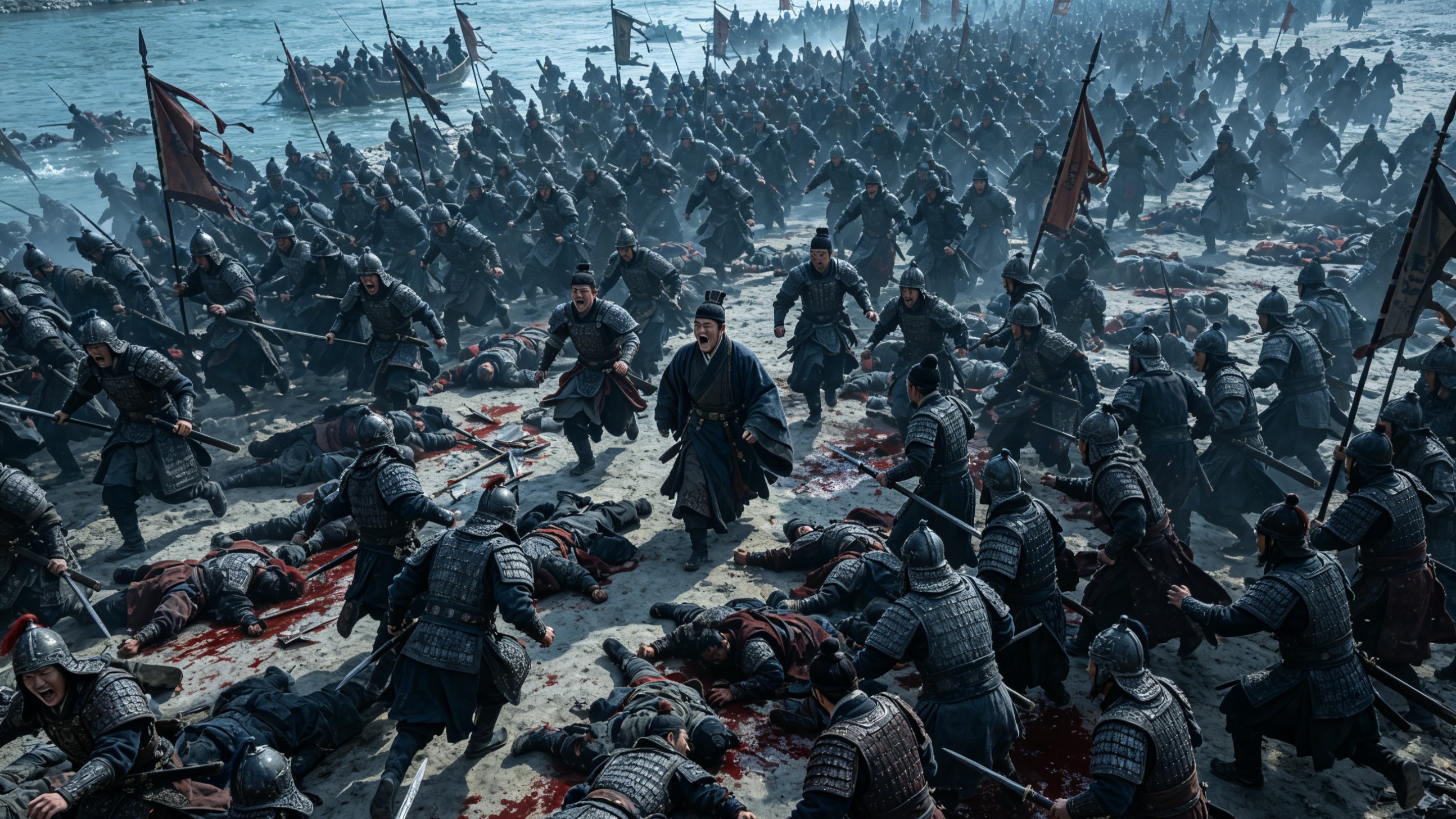
He forgot, however, that his multi-ethnic, hastily assembled army lacked cohesion and discipline. As the retreat order was given, confusion spread. Zhu Xu and his agents among the Qin troops began shouting: "We've lost! Run for your lives!" The soldiers at the rear, unable to see the front, panicked and fled.
In an instant, a million-strong army disintegrated into a stampede, trampling each other, leaving corpses strewn across the field.
Fu Jian, wounded by an arrow, fled north in disgrace. Along the way, the rustling wind sounded like the enemy's war cries, and the sight of cranes in the sky made him think of pursuing soldiers. "Birds startled by a bow, grass and trees mistaken for soldiers" — the once-proud emperor ended his dream of unification in utter humiliation.
📖 Historical Note: The disastrous defeat at the Battle of Fei River shattered the Former Qin empire, while the Eastern Jin preserved its southern territories, prolonging the north-south division for nearly two centuries. Two famous Chinese idioms — "feng sheng he li" (startled by the wind and the cry of cranes) and "cao mu jie bing" (every bush and tree looks like an enemy) — both originated from this battle.