The Mask of Prince Lanling
564 AD | Northern Qi · Gao Changgong
I. A Face Too Beautiful
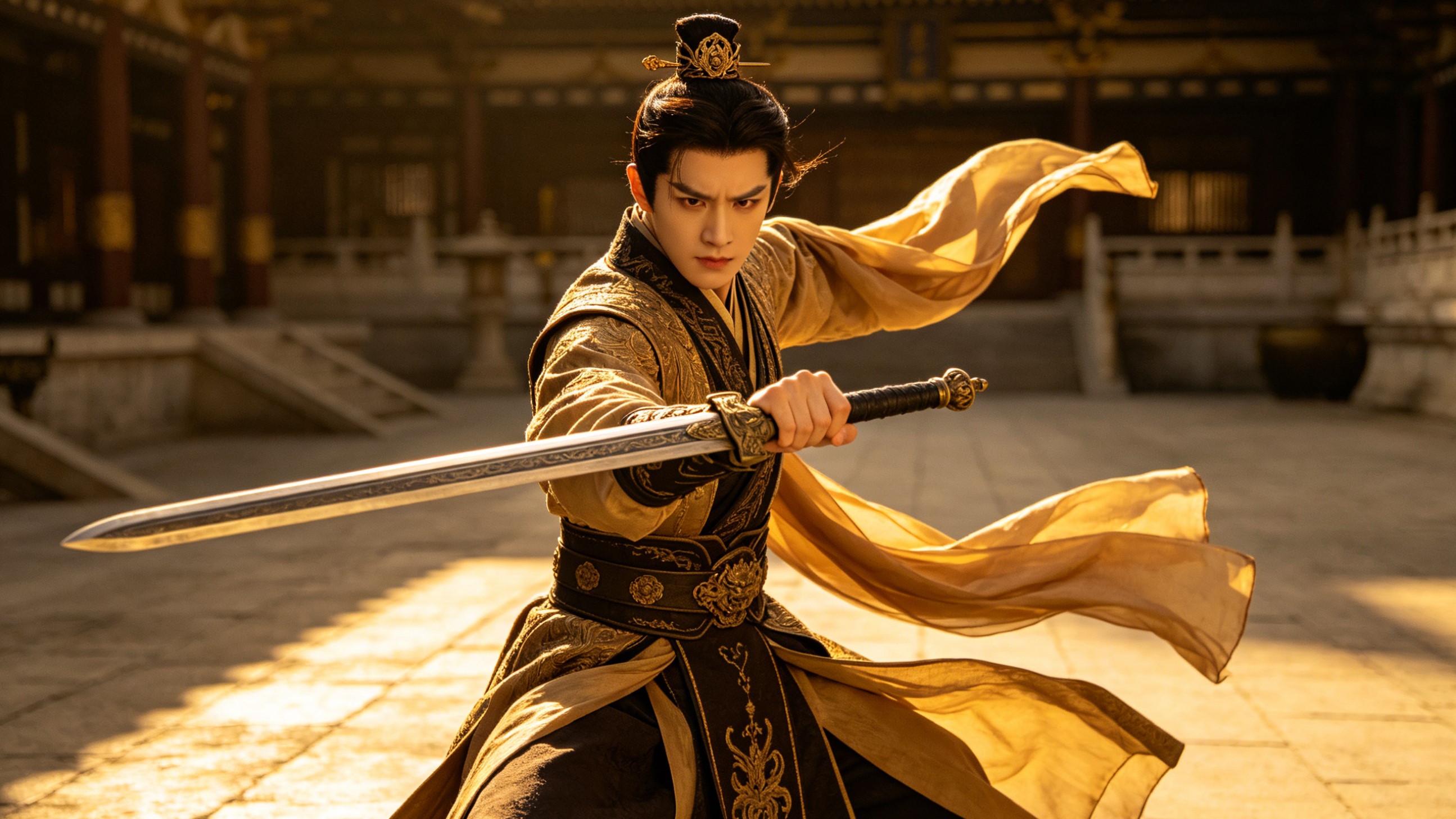
In the imperial palace of Yecheng (present-day Linzhang, Hebei), the young Prince Lanling, Gao Changgong, was practicing with his sword. The early winter sun poured through the latticed window, illuminating a face that could only be described as breathtaking — skin like congealed cream, eyebrows like distant mountains, peach-blossom eyes slightly upturned, lips red as cinnabar. Even the apricot blossoms of March would have bowed their heads in shame before such beauty. But at this moment, that exquisite face wore a frown, and his eyes were sharp as blades.
"My lord, you've been training all morning," his attendant said cautiously, offering tea.
Gao Changgong sheathed his sword, took the cup, and said lightly, "Martial arts rust if not practiced. My family has produced generals for generations; I will not break that line."
The attendant hesitated, then finally blurted out: "My lord, the court officials whisper behind your back. They say… they say you are too handsome. On the battlefield, the enemy will think you are a woman disguised as a soldier. A mere ornament."
Gao Changgong's hand paused. This was not the first time he had heard such words. Every person who saw him for the first time would freeze — who could imagine that the most valiant young general of the Northern Qi royal house possessed a face more beautiful than any woman? Once, even a diplomatic envoy from the Northern Zhou, upon meeting him, had laughed rudely: "Has Northern Qi run out of men? You send a girl to be a general?"
Gao Changgong did not lose his temper on the spot. He returned to his mansion and locked himself in his study for an entire night. The next morning, he summoned the finest blacksmith in Yecheng.
"Forge me a mask," he said, standing by the forge fire. The flames painted half his face crimson. "Bronze. Fierce — as fierce as you can make it. High brow, deep-set eyes, fangs protruding from the lips. I want every enemy who sees this face to feel a chill crawl up from the marrow of their bones."
The blacksmith took the order with trembling hands. Half a month later, a ferocious bronze mask was delivered to Prince Lanling's mansion. Gao Changgong held it in his hands, studying it for a long time. Then he smiled — a smile that held bitterness, resolve, and a cold, killing intent.
II. Five Hundred vs. One Hundred Thousand
In the winter of 564 AD, news reached Yecheng that Luoyang was surrounded by a 100,000-strong army of the Northern Zhou. Gao Changgong was drilling his cavalry on the parade ground. The whip in his hand snapped clean in two.
Luoyang was the last southern barrier of Northern Qi. If it fell, the Northern Zhou cavalry could ride straight north to Yecheng. But in the court, no one dared to volunteer. A hundred thousand vs. a hundred thousand — Northern Qi was not certain of victory, and the defenders of Luoyang were already starving and might not hold out until reinforcements arrived.
"I will go!" Gao Changgong stepped forward. His voice was not loud, but it carried through the entire hall.
Whispers erupted. An official murmured, "Prince Lanling has never commanded a major battle. What if…" Emperor Gao Zhan glanced at his nephew with a complex expression — this nephew was too outstanding, too outstanding for comfort. But he had no choice. He nodded. "Approved. How many troops do you need?"
"Five hundred," said Gao Changgong.
The court burst into uproar. Five hundred against a hundred thousand? Was he going to his death?
Gao Changgong offered no explanation. He returned to his camp and personally selected 500 of his finest cavalry — each one tested, each one willing to die for him. That night, snow fell heavily as 500 riders left Yecheng silently and galloped south.
Two days and two nights of forced march. No rest for man or horse. Gao Changgong rode at the front, his white cloak flying, snow melting on his shoulders. His eyes never left the road ahead, as if he could see through the blizzard to the besieged city.
When they reached Luoyang, night had fallen. The Northern Zhou camp stretched for miles, their torches illuminating the snow like a fiery dragon coiled on the white plain. Trenches, abatis, and patrolling soldiers surrounded the camp. Any other commander would have waited for dawn.
But Gao Changgong did not wait. He knew that the defenders inside had only enough porridge left for one more meal. They could not last until dawn.
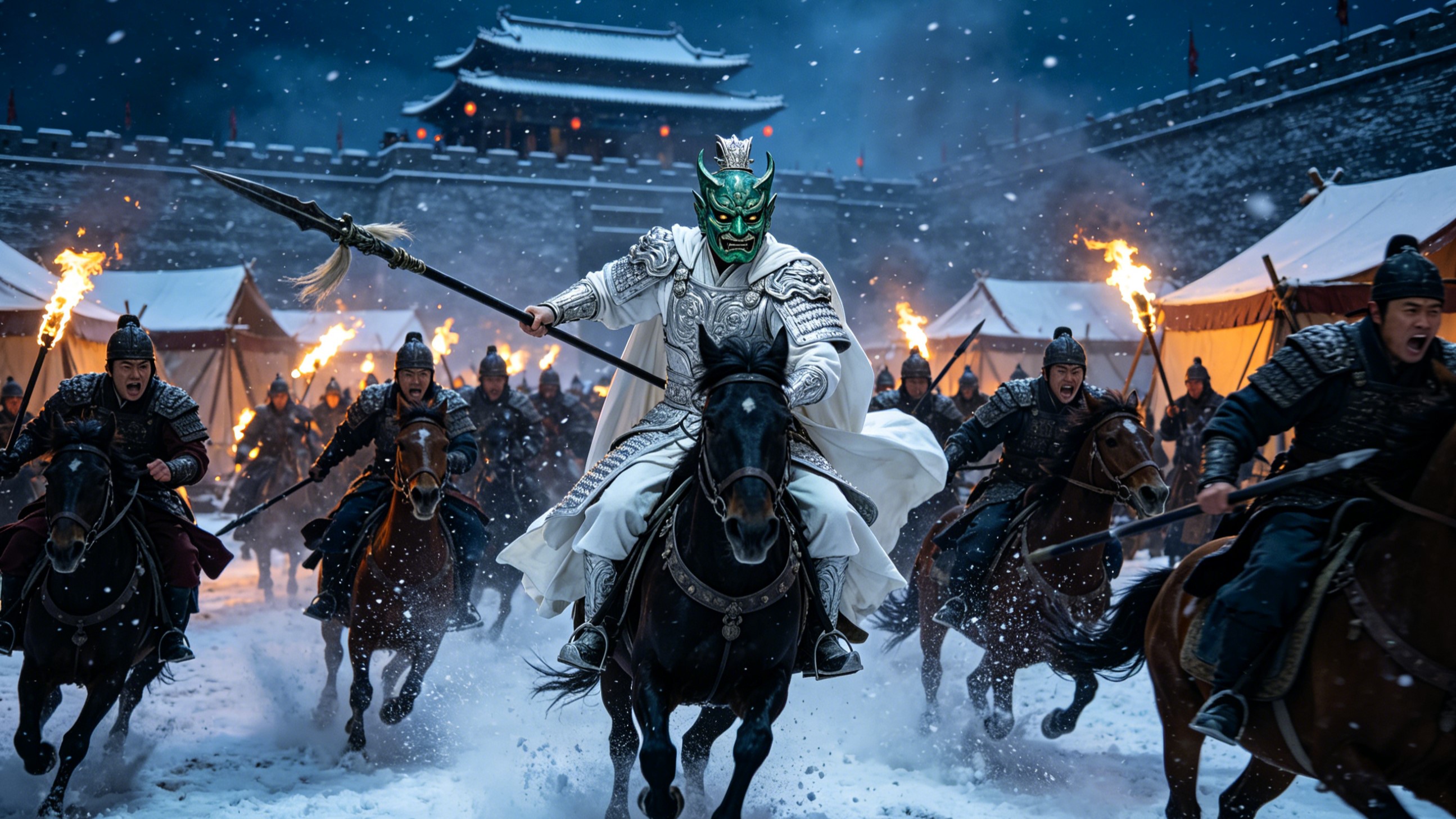
He reined in his horse and turned to face his 500 riders. The snow had not stopped. Ice crusted every eyebrow and beard. Slowly, he took the bronze mask from his waist and strapped it to his face. The cold metal touched his skin, and for a moment he felt his blood freeze. Then he drew his long lance and raised it high.
Five hundred eyes glittered in the snowy night like five hundred cold stars.
"Charge!"
The first war drum shattered the silence of the snowy night. Gao Changgong, white-robed and silver-armored, his mask hideous as a demon, plunged into the Northern Zhou camp like a white lightning bolt. His 500 cavalry followed, hooves crushing ice and snow, war cries tearing through the darkness.
The Northern Zhou soldiers woke in terror. Rushing out of their tents, they saw a white-robed general with a demonic mask, his long lance spilling blood and slicing off heads with every swing. The cavalry behind him seemed possessed, slashing and trampling everything in their path. Someone screamed in horror: "Ghosts! Ghosts are coming!" Others shouted: "It's Prince Lanling! He's wearing a ghost mask!"
A hundred thousand troops were routed in the dead of night by just 500 horsemen. Gao Changgong's lance had cut down countless enemy officers. His white robe was now crimson, his mask smeared with blood and snow, but his arms were still steady and his eyes still sharp. He fought his way to the foot of Luoyang's wall and shouted up: "I am Prince Lanling, Gao Changgong! Open the gates!"
The defenders on the wall recognized his banner by the torchlight — though soaked in blood, the "Gao" character still fluttered in the wind. The commanding general wept tears of joy and frantically waved: "Open the gates! Open the gates now!"
The heavy gates slowly swung open. Gao Changgong rode through, his 500 men pouring in behind him. The soldiers on the wall cheered; some sobbed openly. Gao Changgong took off his mask, revealing a face smeared with gore yet still astonishingly handsome. He gave a faint smile — then slid from his saddle, too exhausted to stand.
III. The Dance and the Poison
The news reached Yecheng, shaking the court and the army. Five hundred horsemen had repelled a hundred thousand and lifted the siege of Luoyang — a stunning victory. Inspired by his bravery, the soldiers composed a song on the spot: "The Dance of Prince Lanling Entering Battle." They danced with wooden shields, stomping to the drumbeat, mimicking the general's slashing movements. Bronze drums thundered, war cries rose wave upon wave — even the snow outside Luoyang seemed to tremble.
From then on, the dance was performed at every victory celebration. Musicians wore replica fierce masks, wielded long lances, and danced with powerful, imposing movements. The dance later spread to the common people and, with the Tang Dynasty envoys, crossed the sea to Japan, where it was preserved intact in Japanese court music, surviving for more than 1,400 years.
But this was also the beginning of Gao Changgong's tragedy. When Emperor Gao Zhan heard of the great victory, he asked in court: "You charged so deep into enemy lines — what if something had happened to you?" Without a second thought, Gao Changgong answered: "State affairs are family affairs. I did not think of my own safety."
Silence fell over the hall. The emperor's face darkened. State affairs are family affairs? The realm of Northern Qi was his, not Gao Changgong's. Did this young man harbor ambitions?
From that day, the emperor's attitude toward Gao Changgong changed. Fewer rewards, fewer summons. Sensing the emperor's suspicion, Gao Changgong's heart turned cold. He had believed that loyalty and bloodshed on the battlefield would earn trust. Instead, he earned only suspicion.
He began to feign illness and refuse visitors. To allay the emperor's fears, he even started taking bribes — deliberately tarnishing his own reputation, making himself seem a greedy man unworthy of concern. His retainers asked, "General, why do you defile yourself like this?" He smiled bitterly: "If I don't, I won't even keep my life."
But it was all in vain. After Gao Zhan's death, the new emperor, Gao Wei, was even more paranoid than his father. One day, a eunuch arrived at Prince Lanling's mansion with a pot of wine, smiling warmly: "His Majesty sends this fine wine to the general."
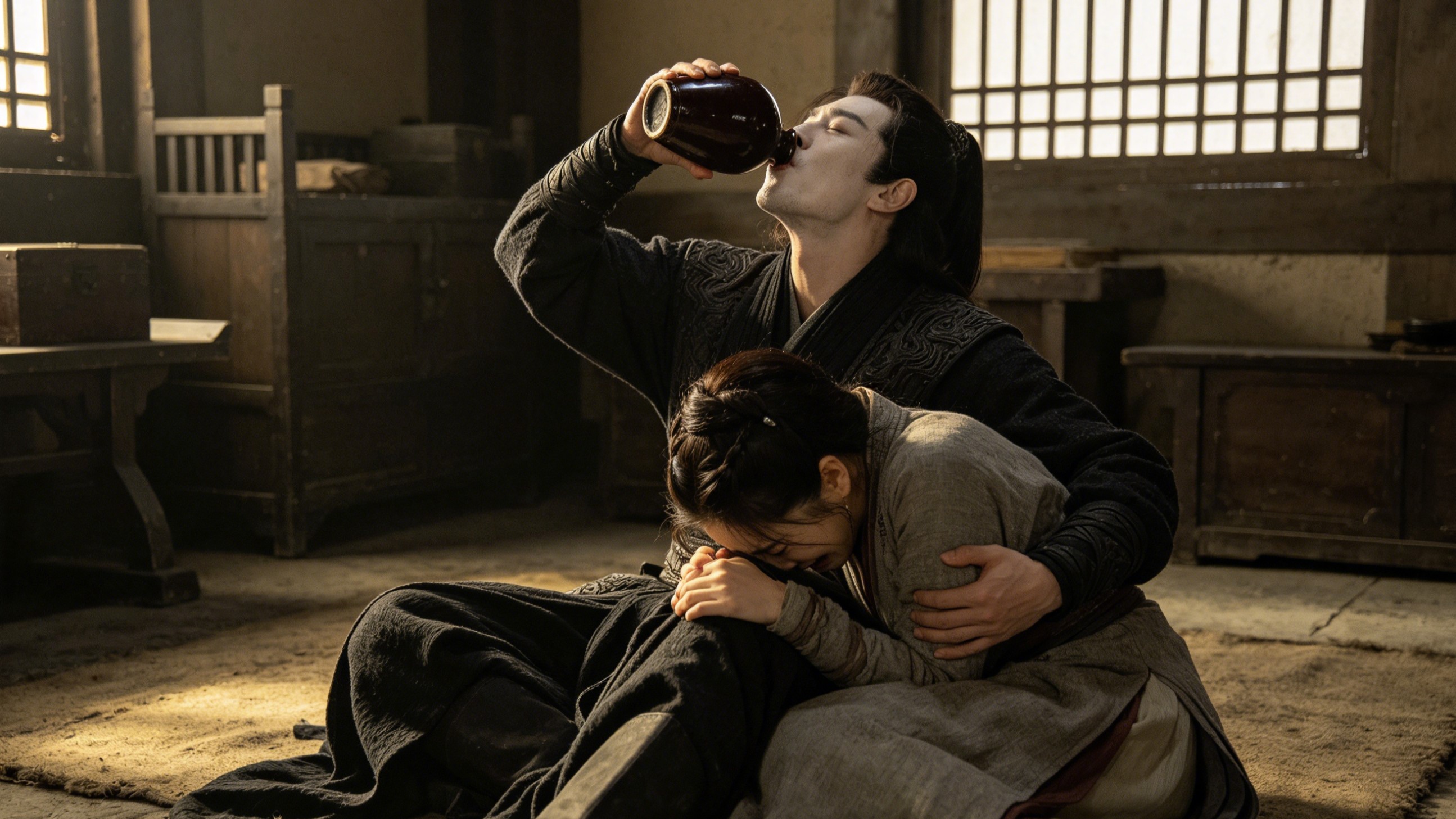
Gao Changgong looked at the wine pot, his face turning deathly pale. He knew — that was not wine; it was poison. His wife threw herself at his feet, weeping: "My lord, beg the emperor for mercy! You have rendered such great service, how can he…"
Gao Changgong shook his head. Tears silently traced his handsome face. He whispered: "You do not understand. To overshadow the emperor in merit — that is a death sentence in itself."
He raised the pot and drank it dry. He was only thirty-three years old.
When news of Prince Lanling's death reached the common people outside Luoyang, they spontaneously burned paper money along the roads, their cries shaking the heavens. They could not read, they knew nothing of power struggles — but they remembered that winter: a white-robed general with a demon mask had broken through a hundred thousand enemies and saved all their lives.
More than a thousand years later, at Kasuga Taisha shrine in Kyoto, Japan, "The Dance of Prince Lanling Entering Battle" is still performed each year. A masked dancer moves to ancient rhythms, wielding a long lance, as fierce as ever. The real Prince Lanling has long turned to dust beneath Mang Mountain. Only his bronze mask remains, watching over the world from the snow and wind of history.
📖 Historical Note: Prince Lanling is one of the Four Great Beauties of ancient China (alongside Pan An, Song Yu, and Wei Jie). "The Dance of Prince Lanling Entering Battle" has been recognized as a Chinese national intangible cultural heritage and is preserved in its complete form in Japanese gagaku music. The mask, white robe, and long lance remain eternal symbols of this tragic hero.